What Do We Do When We Don’t Like It

What the Apostle Peter’s teaching on marriage reveals and why the way we respond to God’s Word matters.

This past Sunday, I had the privilege of preaching from 1 Peter 3:1-7. It was…challenging. Consider: 

In the same way, wives, submit yourselves to your own husbands so that, even if some disobey the word, they may be won over without a word by the way their wives live when they observe your pure, reverent lives. Don’t let your beauty consist of outward things like elaborate hairstyles and wearing gold jewelry or fine clothes, but rather what is inside the heart—the imperishable quality of a gentle and quiet spirit, which is of great worth in God’s sight. For in the past, the holy women who put their hope in God also adorned themselves in this way, submitting to their own husbands, just as Sarah obeyed Abraham, calling him lord. You have become her children when you do what is good and do not fear any intimidation. Husbands, in the same way, live with your wives in an understanding way, as with a weaker partner, showing them honor as coheirs of the grace of life, so that your prayers will not be hindered.

That passage makes a lot of people angry today. But people didn’t like it almost two thousand years ago, either. 

In the first century, in a culture built on the assumption of masculine superiority and feminine inferiority, husbands didn’t want to hear about the sexes’ equality or their responsibility to sacrifice their societal power to honor their wives. 

In the twenty-first century, in a culture committed to radical feminism and the destruction of differentiating characteristics, wives don’t want to hear about submission to their husbands or that “quiet” and “gentle” are valuable traits. 

But it’s not like Peter originally picked on husbands, and first-century wives loved the passage. Or, as if wives today have targets on their backs, while twenty-first-century husbands applaud and cheer the Apostle on. 

No. This passage challenges both husbands and wives now, just like it challenged both then. The feathers being ruffled in the first century have changed here in the twenty-first, but the irritation has the same source: sinful human desires opposed to God’s design. 

That’s why it is vital not merely to consider our specific situation, personally and culturally, when we look at a biblical passage like this one. Instead, we should push beyond our status and experience and consider that “God’s thoughts are not our thoughts, and His ways are not our ways.” Because of both His holiness and our rebellion, He is more likely to say things we do not like than things we do. We should expect Him to call us to behavior and ways of thinking that cut against our natural tendencies. 

This is hard for us. When we come across any information, be it in our Bibles, in a conversation, on the internet, or anywhere else, our first reaction is to evaluate whether we like it or not. Instead of logic or merit, we weigh our emotional response first. Scientists call our species homo sapiens (wise human), but perhaps homo affectus (feeling human) would be more accurate. 

As Christ-followers desiring supernatural transformation, how do we counteract this trend? By changing the question we ask when we come to the text. Instead of asking whether we like the Bible’s teaching, we need to ask whether we are willing to live the Bible’s teaching. 

I don’t like Peter’s instruction to think of my wife and not myself. I don’t feel good about the close link between my relationship with my wife and my relationship with God. I don’t enjoy killing my natural desire for self. But these things are good and right and thus are not to be evaluated based on my desires. 

You may not like Peter’s teaching in this passage. Your skin may crawl at the admiration with which he speaks of Sarah, who obeyed her husband. You may feel threatened by his assertion of equality between husband and wife. But your emotions regarding the text are not the primary indicator of its validity. 

We can, and should, discern the difference between what the text says and what sinful people have manipulated it to say for their benefit.

We can, and should, reject misinterpretations, abuses, and inconsistencies in the application of the text.

We can, and should, embrace good scholarship and new insights. 

But we cannot, and should not, reject any part of the Bible simply because we don’t like it. 

And a wealth of beautifully transformative work occurs when we push through our initial like/dislike reaction to the Word. When we realize that Peter’s words in this passage are lifting women up, not putting them down; when we finally see that husbands who connect with their wives can connect with God as well; when we cease to see our relationships in competitive terms and begin to see them through the lens of connection and mutuality; when we do these things, we begin to see what God intends for our marriages and our lives. 

Marriage is not meant to destroy, restrict, compel, demand, or burden; it is intended to be the engine of life-giving, lifting, building, growing, shaping, blessing, and creating wonderfully diverse unities from unique individuals. In marriage, the whole is greater than the parts, but never at the expense of the parts, only to their benefit. 

God offers us everything we’ve ever dreamed of and more in marriage. What a shame if we miss it because we didn’t like how it first sounded to our fallen ears. 

green broccoli on blue textile
Photo by Önder Örtel on Unsplash

Why? I’ll Tell You Why…

How Peter answers the fundamental question we are all always asking

Why?

“We have the knife with your fingerprints. We have three eyewitnesses who swear they saw you commit the crime. We have your own letter confessing. We know you did it. But what we want to know is why did you do it?” 

So runs the interrogation of the prisoner in every boilerplate crime drama. But the formula works because humans desperately need to know the “why,” not just the “what.” The soundtrack of human life is largely a series of “why” questions: 

“Why is the sky blue? Why do dogs sound like that? Why am I so awkward? Why is she more popular than I am? Why is tuition so high? Why do people expect me to know what I am doing with my life? Why are gas prices so high? Why is my boss like that? Why does every part of my body hurt? Why don’t my kids call more often? Why? Why? Why?”

With the prevalence of the question in our lives, it should not surprise us to find it coming up when we’re looking at Peter’s instructions to the church in the second chapter of his first letter. He tells his readers to 

“Abstain from sinful desires.”

“Submit to every human authority.”

“Honor everyone.” 

“Love the brothers and sisters.”

“Submit to your masters.”

“Do what is good and suffer.” 

Our natural and human response to his instructions is likely a resounding, “Why!?” We don’t like abstinence, we don’t enjoy submission, and we certainly don’t want to suffer.

Why? Why are you telling us to do all this, Peter? 

You may think his answer simple, but its implications are profound: 

For you were called to this, because Christ also suffered for you, leaving you an example, that you should follow in his steps. 

Why, Christian, should you do things that are hard and uncomfortable? Because Jesus did them, and His example compels you to do the same. 

That’s not how we typically think about the Christian life. We think about it in terms of traditions, doctrines, or habits. In our self-focused faith, we would expect Peter to answer the question of “why” with a statement of how it’s good for us, how we can inspire others, or some other omphaloskepsis drivel. 

But he doesn’t. Instead, he tells us that:

  1. Obedience is in the job description (you were called to this).
  2. Jesus showed you how (leaving you an example).
  3. Do what He did (follow in His steps).  

That phrase from this verse inspired Charles Sheldon’s classic novel, In His Steps: What Would Jesus Do? The book has sold over 50 million copies, spurred the launch of the 90’s pop culture phenomenon of W.W.J.D. bracelets, and provided the basis for a two-and-a-half-hour stage adaption that a group of my homeschooled friends and I wrote, directed, and staged to the immense viewing pleasure of a crowd of at least 15 of our family members who we cajoled into attending. I am under no illusions that what we produced was good theater, but twenty-plus years later, I am struck again by the power of this idea that compelled a bunch of teenagers to devote so many hours to such an ambitious project. 

Why should I refuse to do what my body wants, what my culture tells me is fine, and what doesn’t seem to hurt anyone else? Because of Jesus. 

Why should I respect the other party’s president and obey the piddling little rules my H.O.A. insists on changing every summer? Because of Jesus. 

Why should I love, serve, and greet my fellow church member who makes me want to turn and run when I see them coming down the hall towards me on Sunday? Because of Jesus. 

Why should I honor my skinflint boss instead of joining the lunchroom roast session? Because of Jesus. 

Why should I be willing to lose money, go to jail, or even die for doing the right thing? Because of Jesus. 

Christ-follower, you cannot live however you want. You are no longer a free agent, drifting with the winds of the world and the whims of your heart. You are a blood-bought, Spirit-filled ambassador of grace, and God means for you to walk the same way Jesus walked, for the same purpose that Jesus walked.

That’s why.

Sticky Memories & Living Stones

How a couple of rocks in the high desert helped me understand Peter’s discussion of stones and spiritual houses in 1 Peter 2.

Some memories stick to your brain better than others. Superglued to my synapses is the memory of waiting out a rainstorm with my grandpa during an adventure in the Owyhee Mountains of Southern Idaho. I can see him, silk handkerchief tied around his neck, cowboy hat pushed back, looking out across the sagebrush below us. We had taken shelter halfway up a mountainside, under a rock shelf, waiting for the rain to pass. The wet sagebrush smell, fresh and clean, was all-encompassing, reinforced by every shift of the wind. Lightning lit the horizon with spectacular flashes. We talked of nothing and everything while the drops fell.

brown grass field near mountains under white clouds and blue sky during daytime

Like many storms in the high desert, this one didn’t last long. Just as it cleared, we saw the rest of the family in the truck, driving out across the sagebrush below us. Weighing my youth and Grandpa’s age against the storm, they had gotten worried and had come to find us. Unfortunately, before we could get their attention, we heard a mighty “clang-clunk,” and the truck came to an abrupt stop.

We immediately started down the hill to see what was going on. Grandpa and I reached the truck at about the same time my dad crawled out from underneath it. The driveshaft running to the rear wheels had struck a massive boulder hidden by a sagebrush bush. High-centered, with a bent driveline, we couldn’t go anywhere. 

There we were, a hundred miles from civilization, with a stuck truck. So, Dad did what any self-respecting redneck would do: jacked the truck up off the boulder, pulled the driveshaft out, locked in the four-wheel-drive, and we rolled out of there in a newly improvised front-wheel-drive pickup. 

That rock led to a major repair and an indelible memory. 

Rocks can be beneficial, like the one that kept Grandpa and I dry and safe through the storm, or they can be a problem, like the one that hit the driveshaft.

It all depends on the circumstances.

The Apostle Peter knew something about rocks or stones. After all, Jesus gave him his very name, meaning “rock.” Perhaps that is why, in chapter two of his first letter, we find him reflecting on stones:

“As you come to him, a living stone—rejected by people but chosen and honored by God—you yourselves, as living stones, a spiritual house, are being built to be a holy priesthood to offer spiritual sacrifices acceptable to God through Jesus Christ. For it stands in Scripture: See, I lay a stone in Zion, a chosen and honored cornerstone. And the one who believes in him will never be put to shame.

Jesus is “a living stone” and “a chosen and honored cornerstone.” He stands as the beginning and reference point for everything that comes after. 

Peter’s audience, Jesus’ followers, are “living stones” being built into a “spiritual house.” Their connection to the cornerstone makes them valuable pieces of the overall construction.  

The language used highlights a simple fact: these rocks, these stones are beneficial; they are good. Jesus is the best, His followers follow Him, and amazing work takes place for the glory of God and the good of the nations. 

But Peter is not done talking about stones:

“So honor will come to you who believe; but for the unbelieving, The stone that the builders rejected—this one has become the cornerstone, and A stone to stumble over, and a rock to trip over. They stumble because they disobey the word; they were destined for this.”

In Peter’s mind, those who ought to have known better could reject the Living Cornerstone. Instead of being a blessing, it could be a curse for those who stumble over it. 

Rocks can shelter, but they can also bust drivelines. 

Jesus can bless and build, but He can also impede and condemn. 

What makes the difference? Whether or not Jesus is believed and whether or not Jesus is obeyed. Those two things, belief and obedience, go hand-in-hand and cannot be separated biblically. 

Unbelievers reject Jesus, and He is a stumbling block for the disobedient. 

Conversely, Jesus is accepted by believers and is a cornerstone off which a life of obedience can be built and an identity as a living stone can be claimed. 

Is Jesus your cornerstone, or is He a stumbling block for you? Don’t give the easy “Sunday School” answer: ask yourself two questions: 

  1. Do I believe Jesus is God’s Son sent to redeem humanity and reign forever? 
  2. Do I regularly base my decisions on His commands and example? 

A life with Christ as cornerstone comes from answering “yes” to both questions. A life with Him as a stumbling block comes from answering “no” to one or both.

If you answer “yes” to both, Jesus is your shelter from the storms of life, the rock holding your everything together.

If you answer “yes” to the first but “no” to the second, then you’ve caught your foot on Jesus, and you’re stumbling because “unless Jesus is Lord of all, He is not Lord at all.”

If you answer “no” to the first but “yes” to the second, you’re high-centered on the boulder that is Christ: whatever lofty ambitions you may have, you’ve got no power to get anywhere with them.

If you answer “no” to both, then Jesus’ return as the triumphant King of Kings and Lord of Lords will be like a meteor crashing into and shattering your world.

Rocks can shelter, but they can also bust drivelines.

Jesus can bless and build, but He can also condemn and destroy. Thinking carefully about our response to Him is the most important thing we can do.

Keep It Together

Why our tendency to focus on just part of the gospel message has warped our understanding of salvation and how the New Testament, especially 1 Peter, gives us language to help us keep it together.

Regeneration.

Sanctification.

Glorification.

These are some of the most precious words in the English language. Yes, they are large. Yes, they are technical. But they are beautiful.

They are beautiful because these three words highlight different aspects of what the New Testament calls “salvation.”

Regeneration is the gateway. It is the first gasping breaths of the resurrected spirit lately moldering in the grave of death. It is the thumping heart, beating its tattoo of praise, while its stone predecessor lies silent and still. It is the triumphant cry from newborn lungs. It is new life in Christ.

Sanctification is the path. It is the bloody battle: the Spirit, the saints, and the sinner standing bold against the evil alliance of the world, the flesh, and the devil. It is the machete-wielding adventurer, hacking and stumbling through the tearing jungle in search of the city of gold. It is the ultra-marathon, demanding more from the runner than she ever thought possible but creating more in the runner than she ever imagined. It is running after Christ.

Glorification is the destination. It is the street of gold and the stream of pure water. It is rest for the weary and peace for the warrior. It is healing, and hope, and Him. It is reunion and introduction, coming home and all things new, wonderfully wild and gloriously safe. It is dancing and singing and feasting and praising. It is being with Christ.

These three are all in view when we talk about salvation. But they are not equally celebrated or even remembered. At various points in Christian history, the emphasis has been placed on one or another of them, often to the detriment of the others.

To paint with an overly large brush, at times in the story God is writing called “The Church,” we have focused more on glorification, excluding regeneration and sanctification. It didn’t matter whether someone was made new or living for Jesus; the spotlight shone on the pearly gates—the gospel as waiting around.

Other times, sanctification got all the attention. Minimal effort was made to speak of new birth or eternal glory, just “do better” and “try harder”—the gospel as self-flagellation.

Now the predominant focus is on regeneration. “Have you been born again?” “Raise your hand, pray this prayer, and live your best life now.” Don’t worry about transformation; focus on life here—the gospel as snake oil, a miraculous sales pitch that doesn’t change anything.

The Church in our day needs what the Church in every day has needed: to see salvation in holistic, not reductionistic terms. We think we’re helping people when we leave out bits and pieces of the Good News, but we’re not. A partial Gospel makes partial Christians, stunted and malformed, dragging themselves through life, making no case for the beauty of Christianity, causing disgust in those who are meant to be attracted to the transformation Christ offers.

In 1 Peter chapter one, we see all three elements of salvation at work in Peter’s encouragement to his audience.

Regeneration?

“Blessed be the God and Father of our Lord Jesus Christ. Because of his great mercy he has given us new birth into a living hope through the resurrection of Jesus Christ from the dead.”

Sanctification?

“But as the one who called you is holy, you also are to be holy in all your conduct.”

Glorification?

“An inheritance that is imperishable, undefiled, and unfading, kept in heaven for you.”

They’re all there, all part of our salvation.

And we need to make sure we keep them all in view.

That we are rejoicing in and preaching the truth that “unless you are born again, you cannot see the kingdom of God.”

That we are celebrating and declaring the truth that “if anyone purifies himself from anything dishonorable, he will be a special instrument, set apart, useful to the Master, prepared for every good work.”

That we are longing for and living in the truth that “God will dwell with them, and they will be his people, and He will be with them as their God. He will wipe away every tear from their eyes, and death shall be no more, neither shall there be mourning, nor crying, nor pain anymore, for the former things have passed away.”

Hope.

In which, I share some of my personal journey towards hope and also some encouragement from 1 Peter for you to live in hope, as well.

On December 31, 2022, I was hanging out with my church family, ready to ring in the New Year. 2022 was dead to me and needed burying. Our family had faced loss, hurt, and health issues all year. It felt like every day had multiple reminders of my failings and faults. That year, it had seemed like every decision I made was wrong, and every good intention got me slandered.

I was done.

But, as part of our New Year’s Eve festivities, we pulled a big whiteboard into the church gym. My wife suggested having those who wanted to write one word on the board to represent our New Year prediction. We did, and people had a lot of fun with it.

Here’s the board:

Can you guess which word was mine?

Looking at that board, I knew I couldn’t keep dwelling on the negative. I made a conscious commitment that I was going to change my focus. I also knew that all my “hard” times were pretty petty compared to many.

That led me to write my word for 2023: “Hope” (in green, lower right).

As a Christ-follower, I missed hope in 2022. That board, with that word, was a call back to what I knew to be true: with Jesus, there is always hope. I’d been so focused on my problems that I’d forgotten.

It’s easy to lose hope today. We live in an incredibly cynical and despairing society. Even as Christ-followers, it’s easy to drink the cultural water since that’s what we’re swimming in.

But, when you think about it, the prevalence of despair in our day and age is ironic. Here most of us sit, possessors of technologies that prior generations would regard as magical, with the instant gratification of almost every desire a flick of a finger away, and we’re freaking out. Give us access to near-limitless knowledge and the means to alleviate massive problems that plagued our ancestors, and we spiral into hopelessness. With the world at our fingertips and the planet at our feet, we’re stuck frantically propping up our tiny, fragile, purposeless cardboard castles of self-indulgence.

Oh, Christ-lover, this should not be the case! We are people saved for HOPE, defined by HOPE, and meant to live in HOPE.

I love the Book of 1 Peter and recently preached a message from chapter 1, part of which says this:

Blessed be the God and Father of our Lord Jesus Christ. Because of his great mercy he has given us new birth into a living hope through the resurrection of Jesus Christ from the dead and into an inheritance that is imperishable, undefiled, and unfading, kept in heaven for you. You are being guarded by God’s power through faith for a salvation that is ready to be revealed in the last time. You rejoice in this, even though now for a short time, if necessary, you suffer grief in various trials so that the proven character of your faith—more valuable than gold which, though perishable, is refined by fire—may result in praise, glory, and honor at the revelation of Jesus Christ. Though you have not seen him, you love him; though not seeing him now, you believe in him, and you rejoice with inexpressible and glorious joy, because you are receiving the goal of your faith, the salvation of your souls.

Wow. Just wow.

Mercy.

New birth.

Resurrection.

Inheritance.

Guarded by God’s power.

Rejoice.

Praise.

Honor.

Glory.

Love.

Glorious joy.

Salvation.

Living hope.

“Hope” isn’t just a “word of the year.” It’s not just a vague wish that things will get better. Hope is where we live, in Christ. Hope is the air we breathe, in Christ.

And hope is what our world most desperately needs from us right now.

So, how do we live hope? Here are four ideas, drawn from 1 Peter, that can get us started:

Remember that Jesus is alive.

It’s easy to forget this central truth of the Good News we proclaim. It’s easy for Christians to treat Jesus like just another Bible story, to leave Him on the pages of our New Testaments. But Jesus is alive. If I can say it without being blasphemous, He is even more alive today, reigning over His Kingdom and the universe, than when He walked the streets of the Middle East 2000 years ago. We have every reason for hope when we remember that Jesus is alive.

Remember that you are alive.

Seriously. This is one of those things that could go without saying but leave something unsaid for too long, and it tends to disappear or rot. Stephen Hawking, probably the most famous theoretical physicist since Albert Einstein, said, “While there is life, there is hope.” It’s a sentiment that has echoed through the ages of human history, and sometimes we need to let it resonate in our minds when we’re tempted to despair. Life = hope.

Don’t rely on your strength; trust God to guard your hope.

One of my favorite scenes, from one of my favorite movies, based on my favorite books, illustrates this point. I’m talking about the Battle of Helm’s Deep in the movie adaptation of J.R.R. Tolkien’s Lord of the Rings, The Two Towers. Here, the good guys retreat to a fortress that has never fallen, never been conquered, despite wise advice urging them not to trust those defenses. The great, big wall is immense and well-defended, but it has a weak point that the enemy exploits, and within just a few minutes, all hope seems lost.

That happens when we trust our mental fortitude and strength to preserve our hope. Instead, we need to rely on God’s strength to focus our eyes on Him, His Word, His people, and His plan. There are no weak points in God’s power, no exploitable points in His wall. We need to trust Him to guard our hope, not ourselves.

Don’t let trials distract you from your hope in Jesus.

Earlier, I quoted Stephen Hawking. Do you realize how incredible it is that those words came from him? Here was one of the most brilliant minds of his generation, and he used a wheelchair for most of his life. He couldn’t walk, breathe, or even talk on his own. He could only speak those words of hope because a computer synthesizer had been rigged up for him to use. And he didn’t know Jesus. Friends, if a man facing those trials could maintain that kind of hope, how much more radical should our hope be, we who see the hope of Jesus Christ?

Let’s live in hope for the glory of God and the good of those around us and for our own sanity in these despairing times.

You Don’t Count Leaven

Why years of a Christianity obsessed with numbers has missed the point entirely: you don’t count leaven, you look at the bread.

You know Chicken Little, right? 

“The sky is falling! The sky is falling!”

Everyone used to laugh at the naïve little bird and then went on their way. Not anymore. Now, it seems, we’re all Chicken Little. Or Ducky Lucky. Or Turkey Lurkey. 

“The sky is falling! The sky is falling!”

I am not qualified to analyze the truth of that statement when it refers to the climatethe economy, or technology.

But it is increasingly disturbing for me to hear that fowlish refrain coming from the lips of my fellow Christ-followers. 

You can see it in our social media posts, read it in blog posts, and hear it in our hallways on Sunday mornings. In addition to all the fallout from the “unprecedented” past three years, it seems the church in America is rapidly declining. We aren’t reaching new people; the ones we had before have left and don’t seem to be returning. Attendance, baptisms, congregations: all the numbers are trending down

Well, that’s not exactly true. Within my chosen brand of Christianity (THE Southern Baptist Convention®), it seems like the numbers are going up. At least, the number of things we are counting, the voices calling for us to count better, and the pushes for more and more data to be entered are increasing. 

But the actual lives changed by the timeless good news of Jesus Christ? Yeah, that’s hard to count, but it’s going down. 

It seems we’ve stopped being the Church that counts (because it’s making a difference in the world) in favor of being the Church that counts (because of numbers).

Politically, we are counting Supreme Court Justices and votes. Socially, we are counting lawsuits and editorials that go against us. Ecclesiastically, we are counting worship attendance and seeing more gray hair. In each area, the numbers frighten us. But they shouldn’t. We need to remember that the church counts best when it doesn’t. 

Politically, we need to remember that God is not unaware of what is going on. We must remember that, as citizens of a democratic nation, we can and should vote our conscience in the election. But fear, hand-wringing, and anger leading up to, during, and after the voting should have no place amongst us. Whoever is elected president gets four years, maybe eight. Supreme Court justices get a little longer, with the average tenure being about twenty years. The church has survived centuries. It has survived brutal persecution. It can handle anything this country or any other throws against it. The next four, eight, twenty, or even one hundred years are not going to be the stone that sinks the ship of the church. Let’s not try to count votes, justices, or anything else politically as essential to the church’s future. Instead, let’s rejoice in the surety of Jesus’ faithfulness to fulfill his promise…

“…I will build my church, and the gates of hell shall not prevail against it.”

Matthew 16:18, ESV

Socially, the proverbial handwriting is on the wall. Christian morality, formerly an assumption for many, has been rejected. This reality has led some to propose that the church exercise “The Benedict Option,” which means to concede the public square and focus on creating communities of faith similar to monastic orders. Others have doubled down against the decline of influence with pugilistic defiance. Still others seem paralyzed by the reality of a secular culture supplanting the “Christian” one they grew up with. Whether this is due to the church’s frustratingly inconsistent practice of biblical ethics or the rise of the cult of the self doesn’t matter. What does matter is that it will be increasingly clear where the church stops, and culture starts. And that’s only ever a good thing for the people of God. And not in a throwaway, making the best of a lousy situation. Consider Jesus’ words in Luke 6…

“Blessed are you when people hate you and when they exclude you and revile you and spurn your name as evil, on account of the Son of Man! Rejoice in that day, and leap for joy, for behold, your reward is great in heaven; for so their fathers did to the prophets…Woe to you, when all people speak well of you, for so their fathers did to the false prophets.”

Luke 6:22-26, ESV

We get it backward when, as the people of God, we count societal approval as a blessing and persecution as woe. Jesus says strike that; reverse it. Now live it. 

Ecclesiastically, we tally up the number of people attending our worship services each week and compare that to demographics data, and we freak out. The standard narrative is that young people are not coming, or if they did, they’re not coming back again. The church’s situation seems remarkably like that of Elijah:

There he came to a cave and lodged in it. And behold, the word of the LORD came to him, and he said to him, “What are you doing here, Elijah?” He said, “I have been very jealous for the LORD, the God of hosts. For the people of Israel have forsaken your covenant, thrown down your altars, and killed your prophets with the sword, and I, even I only, am left, and they seek my life, to take it away.”

1 Kings 19:9-10, ESV

Many in the church, particularly the older generations, feel like they have nothing to do but crawl back into their stone edifices and glower out at the pagan youth.

God asks, “What are you doing here, Church?”

“Lord, we have been so faithful. We have studied your Word in Sunday School, we have made sure we maintained our buildings, we have dressed respectfully, we have kept our music wholesome, and even more! But Lord, this new generation doesn’t seem interested. They don’t want to meet in our fluorescent cubicles to study the quarterly, they don’t seem to care about preserving our buildings that get used twice a week, they come to church dressed just like they are every other day, and they don’t even know the words to ‘In the Garden’. We are all that you have left.”

Perhaps God’s response is similar to the one he gave Elijah:

“Go, return on your way…I will leave seven thousand in Israel, all the knees that have not bowed to Baal, and every mouth that has not kissed him.”

1 Kings 19:15-18 ESV

In other words, “Church, go back to the beginning. Go back to what I actually told you to do: love me, love people, and make disciples. You’ve confused how you do church with being the church. The methods have to change in order for the message to be received. And don’t worry about the numbers: I’ve got more to save in the coming generations than you can shake a stick at.” 

A Picture

One of the images that Jesus used to help us wrap our heads around the Kingdom He is building is that of leaven in flour. He said,

 “The kingdom of heaven is like leaven that a woman took and mixed into fifty pounds of flour until all of it was leavened.”

Matthew 13:33

That’s it. It’s a short parable. But, oh, the implications, one of which is this: you don’t count leaven; you look to see if the bread is rising. Jesus counts the culture but not the Church. He measures the flour but not the leaven. But the Church changes the culture; the leaven changes the flour. That’s how this thing is designed to work. It’s not intended to be counted; it’s designed to change things from the inside out. The amount of leaven doesn’t matter, but its impact should be undeniable. 

Perhaps if we stop counting, we will see the bread start rising. We’ve gotten so concerned with counting heads that we’ve forgotten about reaching hearts. If we stop emphasizing counting politically, socially, and ecclesiastically, we may start counting where it matters: obedience, faithfulness, and Christ-likeness.

Living Hope (Not Just Talking It)

An introduction to and call to action from 1 Peter

Of all failures, the failure to distinguish between the description of a problem and the prescription for solving it is the one that will lead to humanity’s downfall.

A lot is going on in that sentence. Let me restate it differently: telling me what’s wrong is not the same as fixing what’s wrong, and pretending it is the same will kill us all.

I wonder if either is very clear, but hopefully, you understand. We live in an age when everything is quantified, tracked, and described in exhausting detail. And some of that effort is well-spent and has led to incredible human performance and quality-of-life breakthroughs. But much of it is a smokescreen hiding a disturbing fact: we have no idea how to solve the fundamental problem of life.

Virtually all of the discourse in the halls of power, through social media, and around our TVs right now is describing the symptoms rather than administering the cure.

When someone describes acts of police brutality, gang-related violence, or racial profiling, various segments of society applaud or jeer, and then the arguments start.

When a scientist shares findings related to climate change, vaccine effectiveness, or poverty, different sides will agree or disagree, and then the debate begins.

All those words. All that airtime. All those facts and opinions.

And nothing ever changes.

It is because we have substituted talking about the problems for doing anything about them. And I am further convinced that we make the substitution because we don’t do anything about the problem because we are unwilling to admit the root cause of the problems: sin.

I am not just throwing stones at the godforsaking atheists who imagine there is no such thing as sin. I’m living in the glass house of Christianity, throwing rocks at everyone, including myself. When we fail to remember that rebellion against our Creator is a pervasive and perverse component of every human and every human system, we can talk all day long about the problem, but we will never solve it. Christians are not immune. But we are more to blame because we know the solution and still get trapped in discussing the problems.

At a certain point, talk is death, and action is life.

We need not more description of the consequences of sin, more talking about the various symptoms of our fatal illness, but an embrace of and widespread dispersal of the solution.

That’s why I love the New Testament Book of 1 Peter. Peter writes to believers living in a world that was superficially much different from the one we live in now, but it was fundamentally the same. It was a world that had many problems because it was a world full of sinners sinning. But, unlike us, he doesn’t get distracted by the symptoms or spend much time discussing the problems. Right out of the gate, he goes straight to the solution: Jesus and the new Kingdom that He is bringing about through His people, the Church, and then tells his readers how to live out that solution in their lives in various situations and ways.

That’s why, over the next couple of months, I will be walking through 1 Peter. I will be doing that through Sunday sermons and this blog’s post. The overarching theme of the study will be two words that come up repeatedly in the book: “living” and “hope.” “Living Hope.”

When we see the two words together, we usually assume that “living” functions as an adjective describing what kind of “hope” is in view. It is a passive quality in sight, a description of the type. While that is possible, I want to go in a different direction. Rather than describing, I see these two words as Peter’s prescribing a solution. “Hope” is what we are “living.” The focus is on living, doing, being, and acting out of our hope, not describing our wishes.

We are meant to live. We are meant to hope. We are meant to be living lives of hope.

The world needs Jesus’ people to live hope, not just talk about it.

Why Is Daniel Mourning?

How reading Daniel differently than I ever had before encouraged me in a surprising way (and how I hope it encourages you, too).

In those days I, Daniel, was mourning for three full weeks. Daniel 10:2

“Why is Daniel mourning?”

That’s a question I never asked myself until recently. Usually, when I read Daniel, I look at the sensational “Bible stories.” Daniel and his friends’ vegan diet…interpreting the king’s dreams…the fiery furnace…and who could forget “Daniel and the Lion’s Den,” that Sunday School favorite.

Sometimes, though, I read Daniel to scratch my eschatological itch (it’s not contagious, don’t worry). I dive into the wild and wildly accurate visions that comprise the book’s second half, cross-referencing them with Matthew 24, Revelation, and Thessalonians. Mid-trib, pre-trib, post-trib, beasts and empires: I dissect, hypothesize, and wonder.

But both of those ways of reading Daniel hide something from me: Daniel himself.

Looking at the stories, I see Daniel, but only like we see the hero in a fairy tale: a two-dimensional cardboard cutout, symbolic of some attribute or other, but not really a person. And looking at the visions, I see Daniel, but he is nothing more than a bullhorn in the hands of the prophetic voice.

But this time, as I read, I focused on Daniel; I saw Daniel. I put myself in his shoes. I imagined being dragged away from my homeland as a teenager, forced to endure the taunts of an enemy who had concluded that their gods were better than my God because they’d beaten my family’s army and had the power. I felt his fear, so I marveled at his courage to stand tall and faithful. I smelled the pit’s stench, wondering if I’d have the same faith to wait through that dark night with the teeth and the terror. My heart soared with joy, remembering with him Jeremiah’s promise that Israel’s banishment would end after 70 years. Seventy years of hoping, waiting, dreaming, trusting…

And, crushingly, in the third year of Cyrus’ reign, Daniel was still in Babylon while many of his fellow exiles had already returned to Jerusalem.

In those days I, Daniel, was mourning for three full weeks. I didn’t eat any rich food, no meat or wine entered my mouth, and I didn’t put any oil on my body until the three weeks were over.

I don’t know, but I suspect his mourning was tied to watching his fellow citizens receive what he longed for: home. I don’t know why Daniel didn’t go back, but whether it was due to his age, health, responsibilities in Babylon, or something else, the sorrow had to be heartbreaking.

And, then, to see the vision of chapters 10-12, a messenger from God, a mighty apparition. What would he say? What incredible insight might he share about YHWH’s plans?

“Daniel, you are a man treasured by God.”

The angelic messenger would get around to minor details like the world’s end, but first?

Daniel, you are not abandoned. Your God delights in you. He treasures you. He wants what is best for you. You have not been forgotten. You are right where He wants you. Even though it may not be where you want to be, He loves you right where you are.

Daniel gets to hear what’s going to happen to his people. He is brought into the secret of the end of the age. He is given information and insight that precious few have been privileged to receive, much less managed to get their heads around.

And the angel tells him to seal all that up and quit worrying about where he’s at and what he’s missing out on. He says,

“But as for you, go on your way to the end; you will rest, and then you will rise to receive your allotted inheritance at the end of the days.”

Keep doing what God made you to do, wherever He has put you. When He’s ready, you will get to rest. When it’s ready, you will receive your reward.

I read Daniel differently, and it hit me: Daniel’s God is my God, too.

There is a God who knows the path of every atom in the universe and knows the end from the beginning. His plans include the fates of nations, continents, and entire planets. He speaks, and everything happens. To Him, the known universe is just detail work, and entire libraries are a breath.

That’s my God.

And then there’s me. I am miniscule, invisible, insignificant, with all my fears, my dreams, my contributions less than the dust falling from the world’s smallest grain of sand.

And He treasures me. I am small, but I am His. I know nothing, and He knows that He loves me. I have not been misplaced in the chaos of a swirling cosmos, nor can I get lost. I am forever in His sight, and He delights in me. I fail Him every day, and every day His mercies are new. I’m not a mistake, where I am isn’t a mistake, and I can’t “mistake” my way out of His love. He made me on purpose for His purpose.

And the same is true for you. I don’t know what you’re going through right now, but I hope that encourages you.

Keep doing what God made you to do, wherever He has put you. When He’s ready, you will get to rest. When it’s ready, you will receive your reward.

What’s In A Word?

Considering some components of repentance in response to Daniel 9

I love the comics section of the newspaper. Some people remember getting the paper as a kid and skipping all the boring, adult stuff to get to the “funny pages.”

I did it as a kid, and I still do it now.

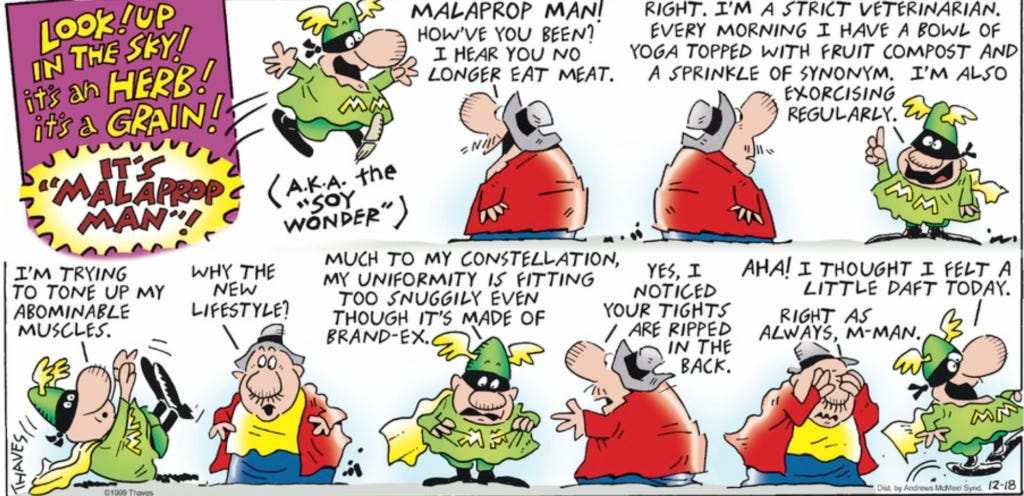
One of my favorite comic strips is Frank & Ernest, mainly due to the semi-regular character of “Malaprop Man.” Consider the following:

Malaprop Man’s superpower is grabbing a word that sounds right but isn’t and running with it. Hilarious absurdities result. As a logophile (lover of words), it appeals to my brain and tickles my funny bone.

Funnily enough, I think about Malaprop Man often church people’s use of words to express our faith. Words like “gospel,” kingdom,” and “salvation” are used, re-used, and over-used, often with a lack of definition or proper understanding.

This post isn’t the place to address all of those, but I want to look at a word that suffers a similar fate but is much less frequently employed in American Christianity: “repentance.”

There are likely many reasons this word isn’t as popular, but there’s one primary reason why it’s often a malapropism: we don’t like it but know that it’s biblical. We feel compelled to use it but feel convicted if we use it correctly, so we misuse it.

We use “repentance” to say we “feel bad” about our actions. We imagine that it means the same thing as “apologizing.” We might even think we intend to “never do it again.” But all of those fall short.

Pastor Sam Storms defines repentance as “a heartfelt conviction of sin, a contrition over the offense to God, a turning away from the sinful way of life, and a turning towards a God-honoring way of life.”

And if definitions don’t move us, there are many examples of repentance in the Bible. Daniel 9 is essential for clarifying our understanding. Daniel gives us a model for true, biblical repentance in this chapter.

A model isn’t a listicle: we should read and respond to the entirety of Daniel’s experience. So please, read the passage and reflect on it before reading here.

That said, there are three components of repentance that I want to highlight because they particularly challenge our modern misuse of the term:

Anticipation

First, repentance is motivated by the anticipation of something better. Daniel is reflecting on the words of the prophet Jeremiah and realizes that the seventy years of judgment that were prophesied are almost completed. Daniel knows that the Lord has promised to bring Israel back to their homes, to the Promised Land, at the end of those 70 years. That’s good news, and it motivates Daniel to repentance.

The same should be true for us. God has promised freedom, joy, eternal life, and more to everyone who repents of their sin. That’s incredible! But if we don’t believe that what waits for us on the other side of repentance is better than anything we could enjoy on this side of it, we will never repent. Anticipation of something better is what creates the desire for repentance in us.

Confession

The next component I want to highlight in Daniel’s example is his confession of sin, both his and his people’s. He confesses both sins of omission and sins of commission. It’s a litany of historical and present failures that must have been painful for Daniel to recount.

It’s always uncomfortable for us to name our sins. That’s why we often euphemize them as “mistakes” or “problems.” We try to minimize or excuse or ignore our sin or the sin of our culture. But true repentance involves honest confession.

Personally, if I lie to the customers who come into my place of business to sell more, repentance requires me to confess the sin of lying and greed. Corporately, if the nation I live in has made its place in the world by the violent theft of property and lives, I should confess our violence, theft, and injustice.

Many of you agree with my statement about personal repentance but balk at the second line about corporate repentance. Why should I confess my nation’s sins? Why should I take the blame for what others have done? Two reasons: first, it is biblical, as Daniel demonstrates. Second, such confession opens the door for the next element of repentance.

Rejection and Redirection

That is the rejection of rebellion and the redirection toward submission. Daniel confesses his people’s choices, and then he rejects that way of life. He highlights the problems that come from living a life ignoring God. He considers that way of life and its effects, turns his back in disgust, and heads in a new direction. It is a conscious choice, motivated by the honest confession that came before and due consideration of both realized and desired effects.

It’s like using a compass to navigate a course change: once we know we’ve gone too far South, we can head North. We can turn to the right way if we see that we are running the wrong way. But if we never take the cover off the compass, never consider which wrong direction we are heading, how will we ever be sure which way to go? We must both reject the wrong direction and start walking in the right direction.

What Now?

Again, I’m not saying that these three elements are all that are involved in repentance. But these three seem important to highlight as we look at our lives and the Christian church in America.

We need to be convinced that what we see is not the best that can be: we need to anticipate something better.

We need to open our eyes to the sin in our lives and our society: we need honest confession.

And we need to choose a different way: we need to reject the rebellion that led us into this mess and redirect into submission.

We will see incredible things happen if we do.

Finding Our Way Through Complexity

What we can learn from Daniel 7 & 8 about looking between, behind, and beneath the trees in order to see the forest.

We live in a complicated world.

Kitchen appliances connect to WiFi, our friendships require multi-billion-dollar corporations to keep us connected, and getting across town can take more computing power than was needed to put a man on the moon.

Humanity complains about complexity, but I’ve begun to suspect that we secretly love it. After all, it’s not like complications are a modern invention. Sure, we’ve dressed it up with more technological coverings than ever before, but a quick history survey should be enough to convince us it’s just the externals that have changed. Underneath, we’ve always leaned towards the byzantine.

Complexity shows up throughout history in our social structures, our art, our sciences, and in our religion.

As an example of the latter, we only need to look as far as the biblical Book of Daniel, chapters 7 and 8. Reading those chapters is enough to make your eyes cross. Two different visions, years apart, with chaos, bodies of water, mind-boggling beasts, strange symbols, and even more. Even more than the text itself, the wide variety of interpretations proposed for these two chapters highlights their complicated nature.

While it’s often fun to dive in and get lost in the details when faced with complexity, stepping back, gaining some perspective, and essentializing the matter can be helpful.

Stepping back from Daniel 7 and 8, we see that, amidst all the symbols, there is a simple contrast between two kinds of kings and the kingdoms they represent.

On the one hand, is the king Daniel describes as “one like a son of man.” This king…

  • …is equated with God Himself
  • …comes down from heaven to set things right among humanity
  • …invites any who will join Him in holiness to reign with Him
  • …builds His kingdom on truth and in peace
  • …never loses His sovereignty, and His reign lasts forever

The other king is a composite based on what Daniel shares of his visions. This king…

  • …is opposed to God Himself
  • …rises up in pride over his fellow humans
  • …dominates anyone who won’t submit to him
  • …builds his kingdom through deceit and violence
  • …is ultimately defeated, and his kingdom destroyed

The contrast between these two kings is simple and easy to see. We can allow the complexity of the text to distract us; we can get into debates about the timing of the events in Daniel’s vision, the identity of the various beasts, and how to fit it all together into our chosen eschatological interpretation.

And that can be fun.

But it is only profitable if we start with what is simple: based on Daniel’s words, which king is worth serving?

We can eventually deal with the details, but they will only matter if we nail down that fundamental choice. Our answer to that one question will ultimately change everything about our lives.

For example: how to live in a complicated world.